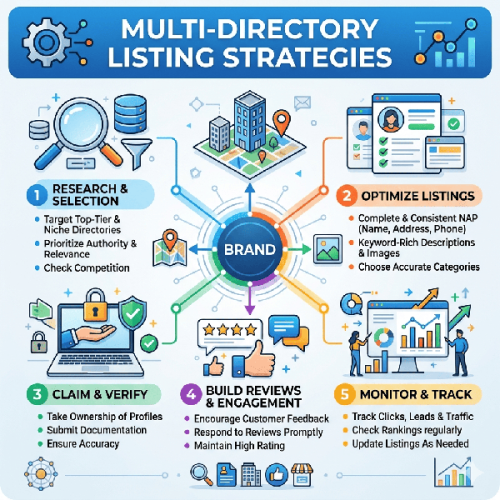
Implementing a multi-directory listing strategy is essential for businesses that want to dominate local search, improve SEO authority, and ensure their brand appears wherever customers are looking.
1. Core Listing Consistency (NAP)
The foundation of any directory strategy is maintaining a "clean" footprint. Search engines use these listings to verify your business's legitimacy.
-
NAP Integrity: Ensure your Name, Address, and Phone number are identical across every platform. Even small variations (e.g., "St." vs. "Street") can dilute your SEO ranking.
-
The Big Four: Prioritize the "Data Aggregators" that feed information to smaller sites: Foursquare, Data Axle, Neustar Localeze, and Google Business Profile.
2. Tiered Platform Strategy
Not all directories are created equal. Distribute your efforts across three distinct tiers:
-
Tier 1: Global Giants: Focus on Google Business Profile, Apple Maps, Bing Places, and Yelp. These drive the highest direct traffic.
-
Tier 2: Industry-Specific: List on niche directories relevant to your sector (e.g., TripAdvisor for travel, Clutch for B2B, or Zomato for food).
-
Tier 3: Hyper-Local: Register with local Chambers of Commerce or community-run business blogs. These offer high "local relevance" signals to search engines.
3. The "Hub and Spoke" Distribution Model
Managing dozens of listings manually is prone to error. Professional strategies often use one of two distribution methods:
-
Automated Sync: Use tools like Yext, BrightLocal, or Semrush to push data from a central "Hub" out to all "Spokes" (directories) simultaneously.
-
Manual Claiming: For smaller businesses, manually claiming the top 10–15 listings ensures better control over photos and specific attributes without monthly software fees.
4. Rich Media and Enhanced Data
To stand out from competitors in a directory list, go beyond the basics:
-
Schema Markup: Use local business schema on your website to help directories pull the correct information automatically.
-
Visual Assets: Upload high-resolution photos and videos. Profiles with images receive significantly more clicks than text-only listings.
-
Attribute Mapping: Fill out every possible field, such as "Wheelchair Accessible," "Free Wi-Fi," or "Online Booking Available."
5. Review Aggregation and Velocity
Multi-directory strategies must include a plan for managing reputation:
-
Review Velocity: Regularly acquiring new reviews is more important than having 100 old ones. Search engines favor "fresh" activity.
-
Cross-Platform Monitoring: Ensure you are responding to reviews on secondary platforms (like Bing or Yelp), not just Google. This signals to the platform that the business is active and responsive.
6. Audit and Cleanup
Over time, "duplicate" listings may appear due to old office locations or varying phone numbers.
-
Duplicate Suppression: Regularly scan for and merge duplicate profiles. Multiple listings for the same location can lead to search engine penalties.
-
Link Building: Use your directory listings to link back to specific landing pages on your site rather than just the homepage to improve deep-linking SEO.

krishna
Krishna is an experienced B2B blogger specializing in creating insightful and engaging content for businesses. With a keen understanding of industry trends and a talent for translating complex concepts into relatable narratives, Krishna helps companies build their brand, connect with their audience, and drive growth through compelling storytelling and strategic communication.